Every Phone I’ve Ever Owned.
I’ve always been fascinated by the aesthetic evolution of technology.
We’ve seen it a hundred times. A new technological innovation enters the market, and at first, designs are basic, low-risk, safe and easy to sell; this is new territory after all and the last thing you want to do is scare customers away. But it’s not long before other manufacturers get on board, the technology gains popularity, customers are interested and they always want more. Suddenly every company is desperately trying to make sure you buy their version of the next big thing. Designs become more risky, colourful, luxurious, interesting, and the concept is reinvented over and over, the tech shrinks in size, then grows again, additions are made and then taken away, until inevitably innovation begins to plateau. This once fantastic new thing is now just another part of every day life, manufacturers no longer necessarily need, or want to take aesthetic risks, and we finally enter the dull, functional, block box stage. And sure there are still some companies taking risks, attempting to innovate and reinvent the wheel, but they’re now in the form of small start-ups and independents trying to make their mark with something different, but innovation is risky at this point, expensive, and often ends in failure, especially when you’re up against “big tech” who already completely dominate the industry worldwide.
As a result of all this fascination, I decided, due to a recent post on BlueSky, to not only show my age, but to share my own personal technological journey in the form of every mobile phone I’ve ever owned. From my very first mobile phone 25.5 years ago, right up to what I’m using now.
With each phone I’ll provide an image either from online or a photo of the handset if I still have it, some basic details, approximately when I used it, my age, how I acquired them, why I stopped using them, and any other interesting tid-bits from my experience with the phone, and interestingly, whether I actually still own the handset. And spoiler alert, I have kept quite a few!
So lets start at the most logical place. The beginning…
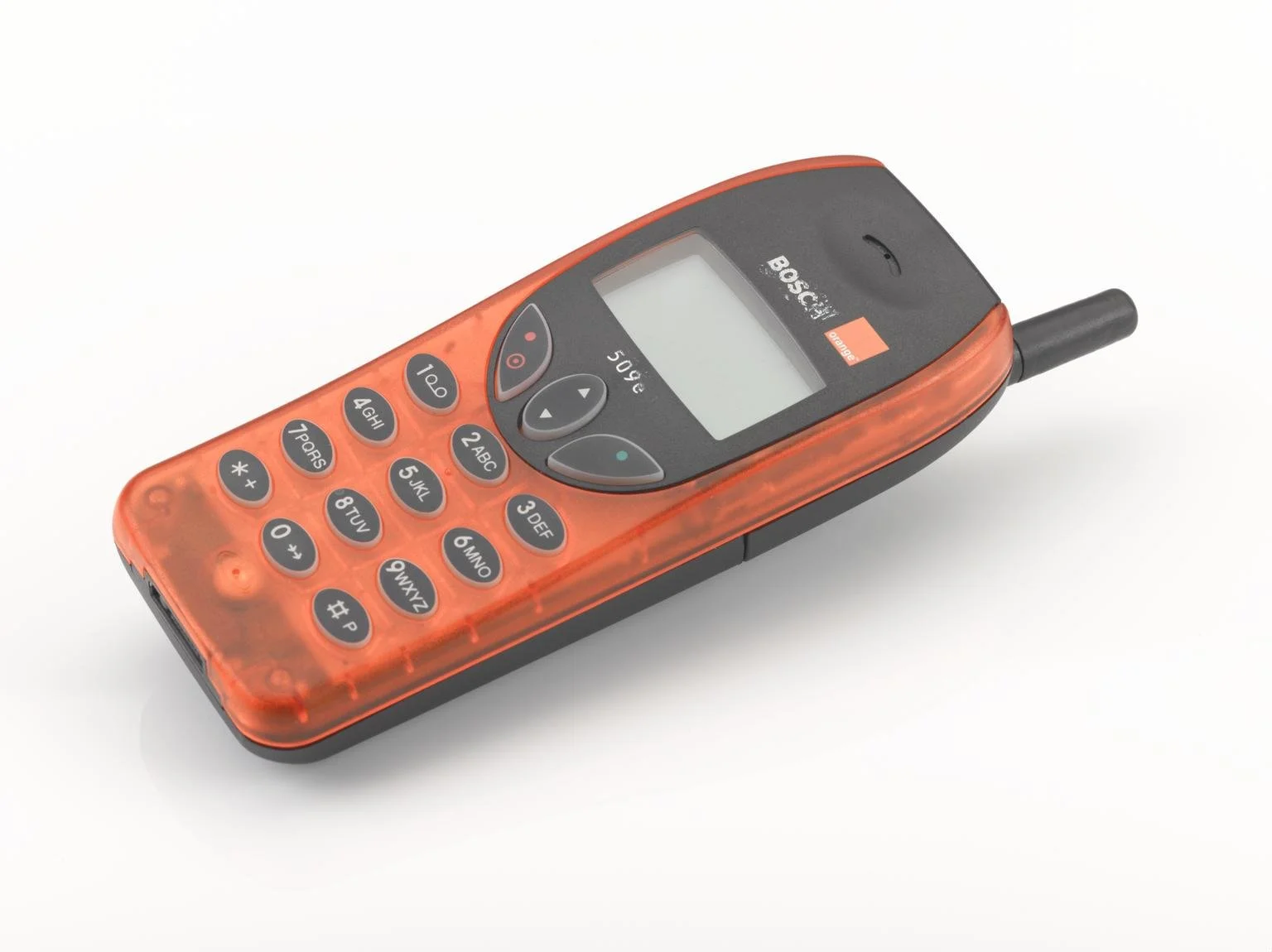
BOSCH 509e
Manufacturer: Bosch
Network: Orange (UK)
Released:
1999
When I Used It:
2000-2001
Do I Still Own It: No
Would I Still Use It: Yes
Image Source: The Science Museum / Licence CC BY-NC-SA 4.0 Licence
I bought my first phone, the Bosch 509e, on my 15 birthday for a bank breaking £30 on PayAsYouGo from Orange, which when adjusting for inflation, would still only cost around £60 today. Bargain.
None of my friends at school owned a mobile at the time (although one did own a pager), so it was a little bit pointless owning a phone, but it did aid in replacing the need for the BT Chargecard my mum had given me, and it certainly wasn’t long before my friends started convincing their parents to buy them a phone, and my phone book began to fill.
Text messages cost 10p per message at the time on my PayAsYouGo plan, so I would only get 100 messages per £10, which even though barely anyone had phones at the time, for a teenager, this was just not enough, and needless to say my mum got very fed up with me constantly asking for £5 and £10 to top up my phone and probably wished I still used the BT Chargecard.
I used this phone until I was around 16-ish, and in that time it went everywhere with me. It was the first phone where I experienced this crazy new concept of nervously texting girls I had a crush on, and it even saw my very first girlfriend. It’s safe to say I LOVED this phone, and still do. So why did I get rid of it? Well, I personally didn’t.
It was English class, Year 11. The pips had just sounded and we were packing away our books. Mobiles phones weren’t allowed in school back then, and so I had to always hide it away in my bag on silent or risk my teacher confiscating it. At some point during the lesson, my phone had somehow fallen out of my bag, and when I came to leave class it was gone. No trace. I checked over every inch of the classroom, I tore my bag apart multiple times. No luck. I eventually relented, and admitted to my dragon of an English teacher that I had a phone with me, but had lost it. She didn’t care, and instead I was scolded for having the phone in the first place. I went home heartbroken that day, and immediately called Orange to have the phone blacklisted and blocked using the IMEI, so even if someone swapped the SIM Card, no-one would be able to use it at all. My first phone was officially gone, and even if I found it, it had been bricked by Orange. All those numbers, all those texts, memories. Gone.
I later found out that when it had slipped out of my bag, a classmate, who I will just name “J” had picked it up. Putting it bluntly “J” was basically a real prick; one of those class trouble makers who was up there in the top ten of “Most likely to end up in jail”. I was informed by a mutual friend that “J” had seen my phone on the floor under the table, grabbed it, knowing full well who it belonged to, and sold it that evening. As mentioned, the phone was bricked and useless, so I hoped that “J” he got a well deserved punch in the teeth from his customer, but this was never confirmed for me, and wouldn’t bring back my phone anyway.
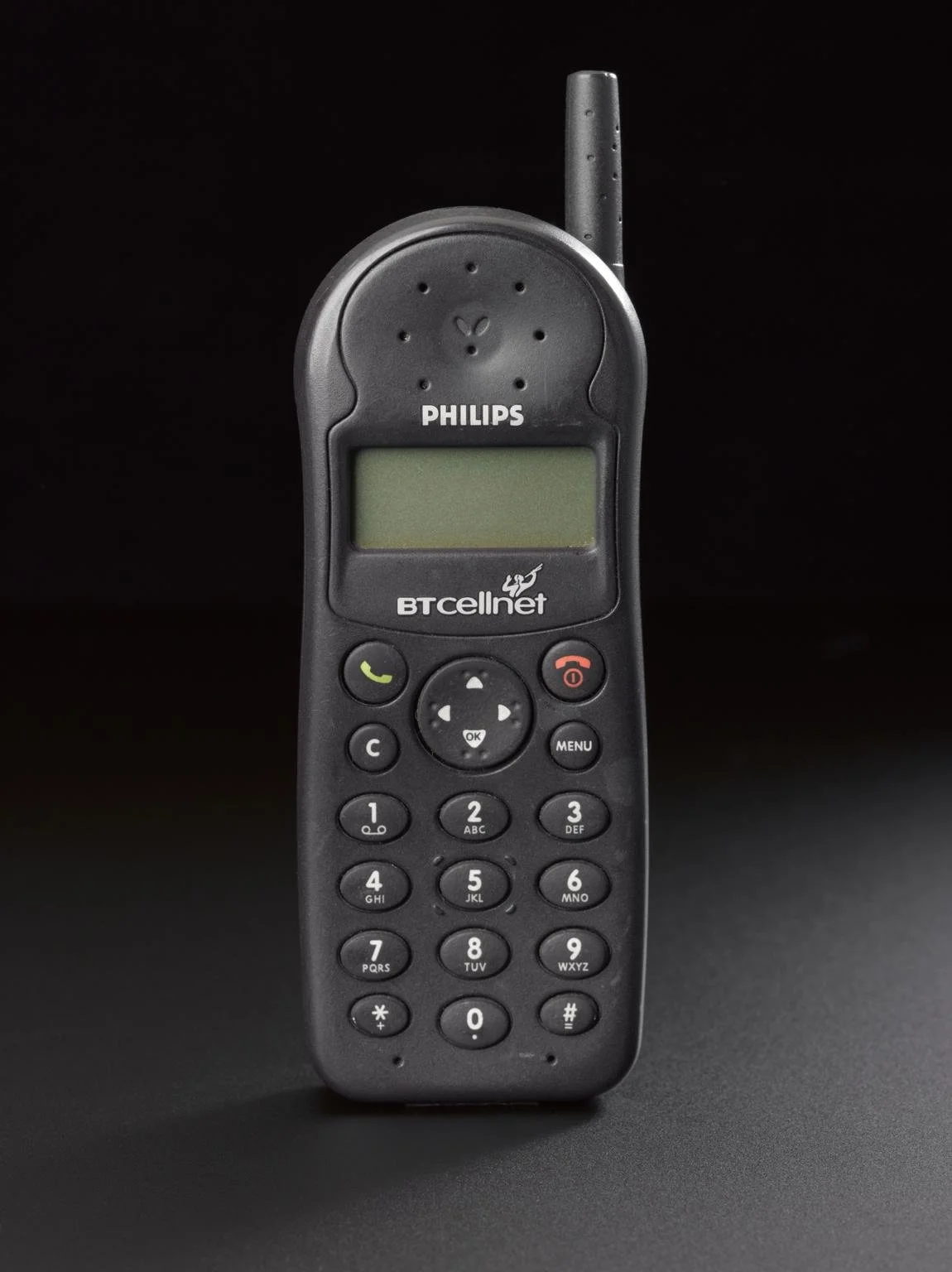
Philips Savvy
Manufacturer: Philips Electronics
Network: BT Cellnet
Released:
1999
When I Used It:
2001
-2002
Do I Still Own It: No
Would I Still Use It: Yes
Image Source: The Science Museum / Licence CC BY-NC-SA 4.0 Licence
After the devastating loss of my Bosch, I was without a phone for a short while. It was 2001, I was 16, and all my friends now had phones, and it sucked. I could still chat to them outside of school on MSN Messenger, but it wasn’t enough. What was I to do when my mum was using the phone and so I couldn’t get online, or it was my brothers turn on the house PC. This was the dark ages of dial-up Internet and one computer in the entire household after all.
My mum had recently upgraded her phone. For a long time she had been using, what even then we referred to as “The Brick”. It was a Philips TCD308. It was a beast of a thing, and she had finally decided it was time for something new, and so she went with the Philips Savvy. It was a very dark subtle purple colour, with an equally very subtle glitter effect, and I wanted it. Looking back, I feel guilty that my mum gave up her new phone for me, but she agreed with all my arguements as to why I definitely desperately still needed a mobile phone, and decided to go back to The Brick, on the agreement that it was only temporary until I got a replacement for my Bosch. I was back in business!
I added all my friends, including some new ones, and it wasn’t long before I found someone else, who conveniently I had a huge crush on, with the exact same phone to take advantage of one VERY cool feature. Picture Messages.
When I say picture messages I of course mean very low detail pixelated preset emoticons which could only be received by other Philips Savvy users and would appear at the side of the text messages once sent. But picture messages nevertheless, I was living in the future!
With some very smooth messages, and clever use of emoticons, that crush eventually became more, and I entirely believe I had that phone to thank for it. Of course it wasn’t to last as we were only teenagers, and much like the phone, a few months later, we both moved on. The time had come to replace the Savvy as I had finally found a replacement for my Bosch. I reluctantly gave the Savvy back to my mum, as it was time for my third phone, and an another exciting new feature.
Panasonic GD35
Manufacturer: Panasonic
Network: BT Cellnet
Released:
2001
When I Used It:
2002-2003
Do I Still Own It: No
Would I Still Use It: Maybe
Image Source: Avito.ru
One day my brother came home with some items he’d purchased from a friend at school. A basic DVD player, a couple of mobile phones, and some other electronics, all brand new. His friend worked at the electronics retailer Currys in the UK, and got a significant discount on products at the time, and so he would buy the items on discount, and sell them on at a slightly lower than retail price, making a small profit. Great idea I thought.
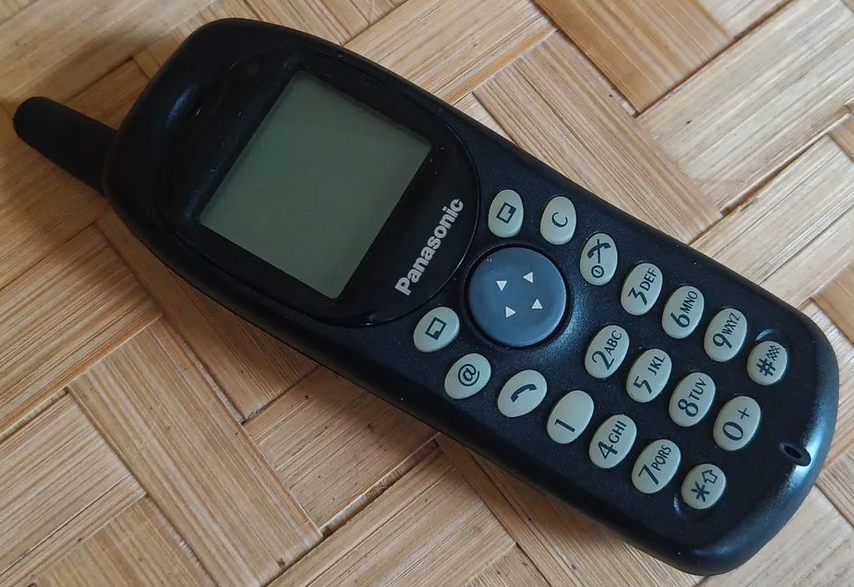
My brother took the now iconic Nokia 3310 from the bundle to replace his equally iconic Siemens C25i, and offered me the Panasonic GD35 for £20. It seemed pretty basic, but it was new, had a cool shape, was smaller than the Savvy, but more importantly I noticed two very interesting things on the phone. Firstly, the Number sign (more commonly known as the Hashtag nowadays) had some zig-zag lines next to it, and curiously, there was a button with an @ symbol on it.
Despite phones becoming more acceptable, they were still frowned upon in school at the time, but by this point I was a sixth former in year 12. We had slightly more freedoms, but if your phone went off in class you still got dagger eyes from your teacher. What these zig-zag lines meant is that for the first time, I would now own a phone with a vibrate function. This was a game changer. I could have my phone in my pocket at all times, and without needing to check it every five seconds, I would know exactly when I received a call, or more importantly a text. But what about that @ symbol?
The @, well if vibrate blew my mind, you can only imagine my delight at realisng my phone had WAP! No, not that kind of “WAP”, get your head out of the gutter. This phone had Wireless Application Protocol 1.1, one of the early mobile technologies that allowed users to access the internet via a mobile phone. My mind was blown. If preset emoticon picture messaging on the Savvy was the future, I was now in a whole new dimension.
The WAP function allowed me to check emails, browse a few very basic websites, and use a very basic version of MSN Messenger. That’s right, I could now speak to my friends on MSN Messenger when the PC was being used. But this of course wasn’t a free service, and had a cost per minute. I forget the price now but it was relatively cheap, however, with how long websites would take to load, and the need to constantly refresh Messenger to load new messages, you could easily and quickly eat into your credit.
I had this phone from around 2002-2003. And in that time I almost lost it once, when I accidentally left it on a sliding keyboard drawer in college and traveled around 20 miles and 25 minutes by train in the direction of home, before realising my phone was missing, and boarding a train back in the opposite direction to retrieve the phone, which somehow was still sitting exactly where I left it despite another class using the room. I dropped it on the floor on a walk one day and broke the small plastic cover on the aerial, which at first I glued back on, but the glue never held and I resorted to removing the plastic cap, and subsequently lost the actual aerial, and had to resort to jamming a paper clip inside to make it work again. And I was mugged at a train station, almost losing the phone until the guy realised what a heap of shit it was with my “modifications”, and so he took my only £5 and left. So why did I stop using it? Well aside from the janky aerial, it was phone four that was just too tempting to resist.
I also later found out, long after I had parted ways with this phone, more about that the great staff discount my brothers friend used to get on electronics from Currys. It turns out, it was the kind of discount my dad used to refer to as “fallen off the back of a lorry”, you know, a “Five-Finger Discount”. Turns out his friend was a key-holder for the store at the time and when locking up the store, he would wait until all the staff had left, and help himself to a few products into the back of his car, which he would then sell for slightly more profit than I first was aware of. I have no idea if he was ever caught, in fact I didn’t know him, and my brother has long since lost touch with the guy. But there we go, I was using a stolen phone. Lets move on…
NOKIA 3210
Manufacturer: Nokia
Network: O2
Released: 1999
When I Used It:
2003-2004
Do I Still Own It: No
Would I Still Use It: Absolutely!
Image Source: The Science Museum / Licence CC BY-NC-SA 4.0 Licence
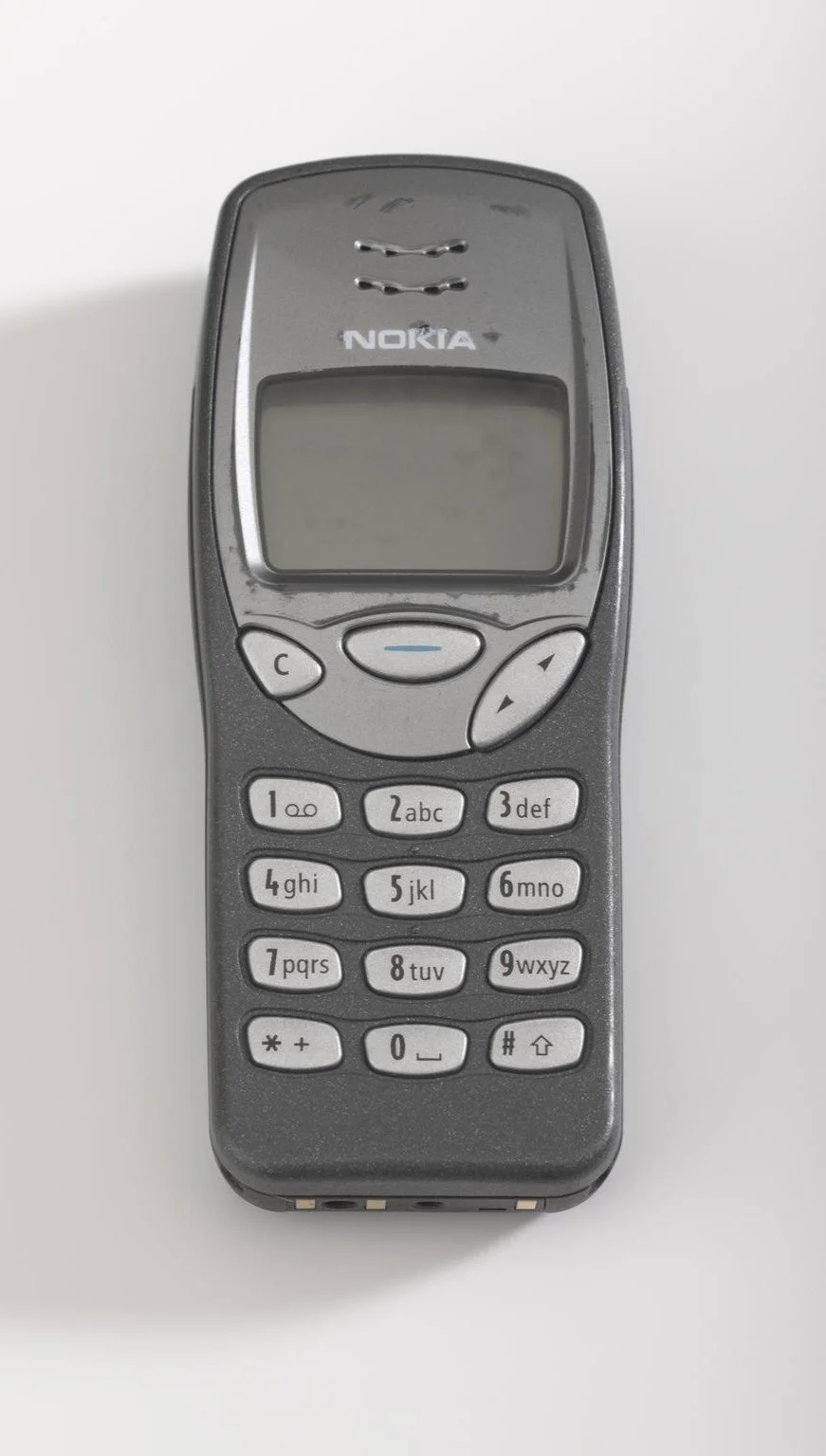
I enjoyed the Panasonic GD35, but with the damage to the aerial, it was becoming more and more unreliable, but what finally made me switch was an offer I simply couldn’t refuse. It was 2003, I was 18, and I’d been with a girlfriend since 2002 at the time. She had just upgraded from her Nokia 3210, to a slightly more modern Nokia, I forget the model, and so she asked if I wanted her old 3210 to replace the GD35. Needless to say I leapt at the opportunity!
The 3210 had been around since 1999, so was about 4years old at that point, but was still a very popular and common model. It didn’t have internet, it didn’t have vibrate, but what it had was the ability to make a statement. It had custom composable ringtones, custom backgrounds, albeit small and pixelated, but the coolest function for me was the customisable shell. You could purchase aftermarket front plates and back plates, completely remove the phone from the stock shell, and replace it with something that showed off your personality to the world. You could even mix and match the front and back plate, the customisation was essentially endless, and I bought a ton of them!
I absolutely adored this phone. It was cool, it told everyone who I was, it had predictive text which was very handy, was built solid as a rock, and the battery just lasted forever; but unfortunately my ownership of it did not. The relationship came to an end in 2004, and with it, I was forced to return the phone. But all was not lost, as the 3210 had a younger brother, and I had an older brother.
Nokia 3310
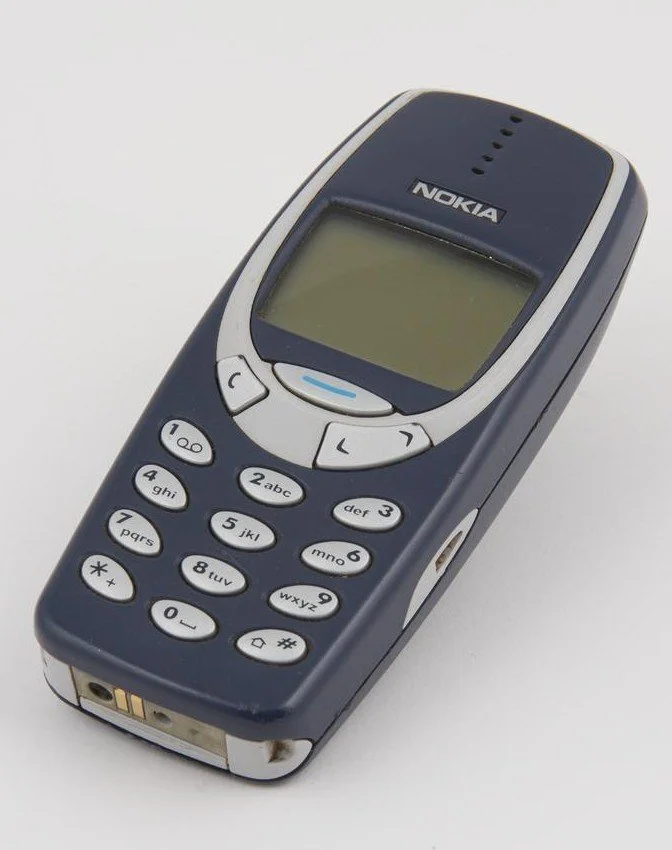
Manufacturer: Nokia
Network: O2
Released:
2000
When I Used It:
2004
Do I Still Own It: No
, but my brother does
Would I Still Use It: Probably not
Image Source: The Science Museum / Licence CC BY-NC-SA 4.0 Licence
So as mentioned earlier, when I acquired the Panasonic GD35, my brother also acquired a Nokia 3310, the successor to the Nokia 3210. Once I had handed back the 3210 in 2004, I needed a new phone and fast. I knew that my brother, since upgrading from his 3310, still had the handset stashed away in a drawer on his desk, likely never to be used again. So without his knowledge, I allowed myself to borrow it, temporarily of course.
In terms of features, for me this wasn’t a major upgrade. I’m sure there was more going on under-the-hood compared to the 3210, but it essentially did the same for me as the 3210 did, just in a smaller body. I didn’t invest in any customised covers as I only used it for a short period of time, and generally wasn’t actually the greatest fan of it. Although if you’ve never owned or held one of these, the rumours are true, these phones were built to last and were borderline bullet-proof!
There’s no real interesting stories with this phone, it was transitional, but I was 19 now, and so it was definitely about time I legitimately bought myself a new phone, as technically I hadn’t actually bought a fully legal, brand new phone, since the Bosch 509e.
O2 X1i
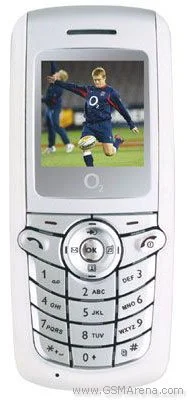
Manufacturer: BenQ (Licensed to O2)
Network: O2
Released:
2004
When I Used It:
2004
-2005
Do I Still Own It: No
Would I Still Use It: Absolutely not!
Image Source: GSMArena.com
This phone. This god damn phone. What a mess.
In 2004, BenQ released their M300 and S660C handsets, and in 2006 their M580 model. O2 then licensed and renamed the M300 as the O2 X1i, the S660C as the O2 X2, and the M580 as the O2 X2i.
Of the two initial handsets, the O2 X2 was the one to have, but with a price tag over £100, I couldn’t afford such luxury, so instead I opted for the X1i, which cost me around £60 at the time (around £110 today). And oh boy was it not worth it.
This was my first camera phone, but all that excitement was quickly dampened as it had problems from day one. The screen was ok, the handset was very small (which was all the rage back then), and the phone did its basic functions, but the build quality was garbage and it creaked and cracked when I used it, and whether the battery was full or not, it would just turn itself off all the time by itself. As you can imagine this was incredibly frustrating when I was mid way through a text or a call. I was too shy back then to go back into the store and complain and ask for a refund, so I just put up with the phone and its problems. I later found out, long after parting ways with this cursed thing, that O2 actually announced a recall of all X1i’s due to the power issue I had long suffered and were replacing them with an updated version with all the bugs ironed out, the O2 X1b, which was also just an O2 licensed version of the BenQ M315.
I used the X1i until sometime in 2005, and how I didn’t absolutely lose my mind with it is a mystery, but eventually it’s problems became too frustrating to tolerate, and if I remember I went back to the Nokia 3310 for a short while before acquiring my next phone. my first Samsung.
Samsung E600
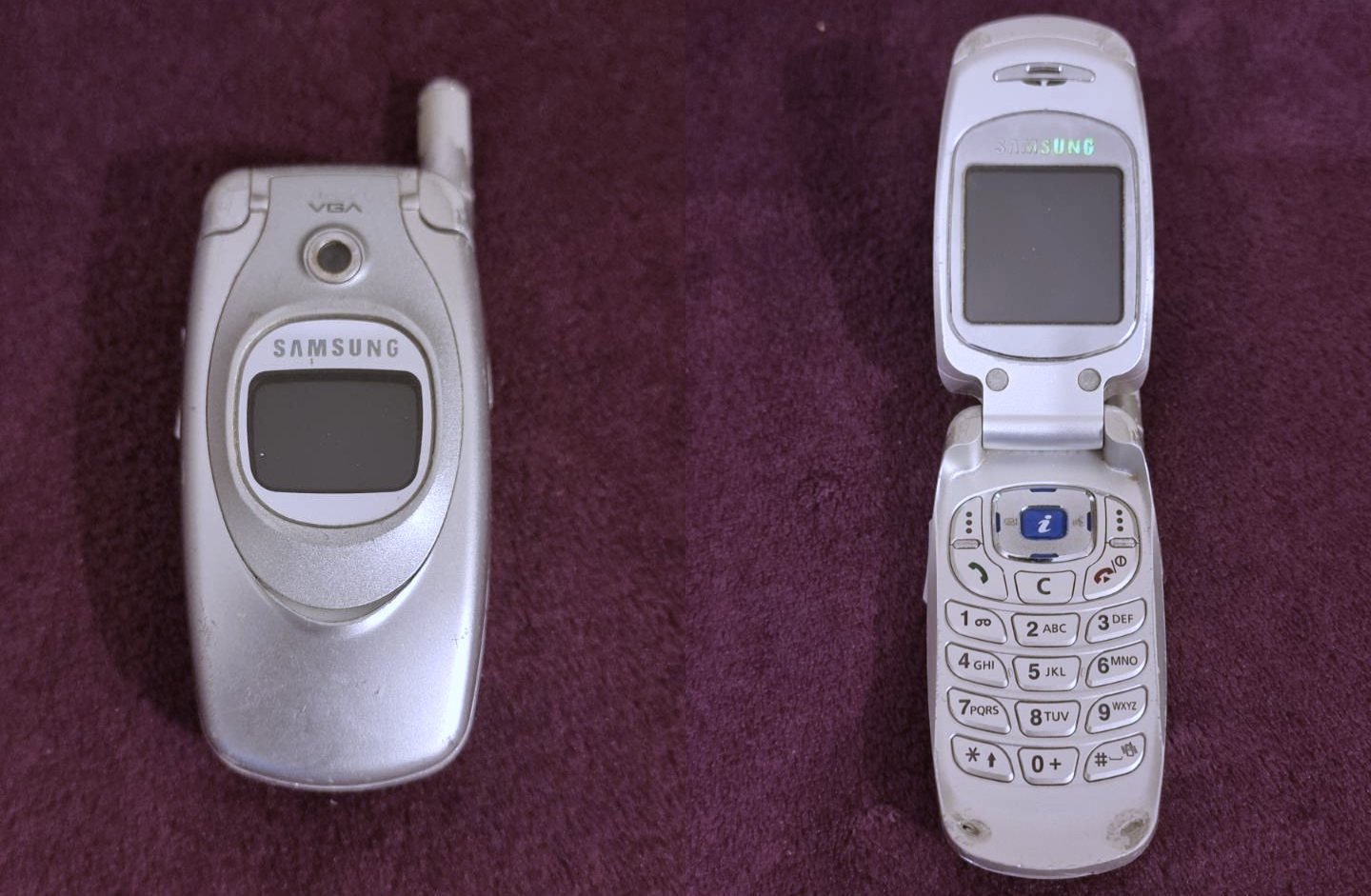
Manufacturer: Samsung
Network: O2
Released: 2003
When I Used It: 2005-2006
Do I Still Own It: Yes
Would I Still Use It: Unlikely
Image Source: © 2026 BoomstickFlip
I acquired this phone in 2005 from a girl named Sian, a friend of mine from my college course who had just recently upgraded her phone. Well aware of how terrible my phone was at the time, Sian offered to sell her old Samsung E600 to me for £20 and a pack of 20 Mayfair Blues. Despite being a year older than my X1i, the E600 trumped it by miles and I quickly accepted the offer.
Compared to the X1i, the build quality was solid, the camera quality was far superior, the screen was clearer and brighter, and overall it was just a better experience. I didn’t intend for the phone to last me that long, but it helped cover the gap between ditching the X1i and working towards a new phone. It had all the bells and whistles at the time that had pretty much become standard on mobile phones, including a camera, internet access, colour screen, and so on. My only real issue with this phone is that I found it was just too small for my hands, with the keypad only measuring a few inches. I’m not sure when or why I stopped using this phone but it would have been around early 2006, when someone I was in a relationship with at the time upgraded their phone to a new Nokia, of which the model number escapes me, and they gave me my next phone, which was their relatively new, old phone.
LG KG800
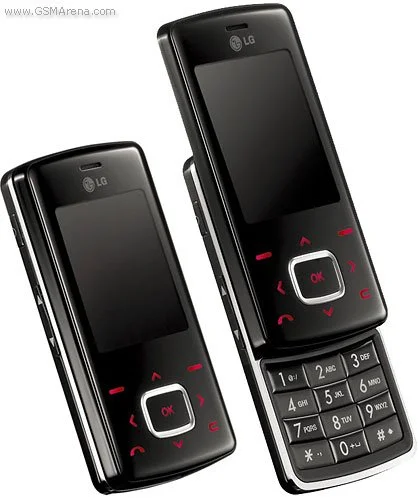
Manufacturer: LG
Network: Orange
Released: 2006
When I Used It:
2006
Do I Still Own It: Yes
Would I Still Use It: Unlikely
Image Source: GSMArena.com
I used this phone literally for a couple of months. It wasn’t great, it wasn’t terrible. I don’t really have much to say about it at all, other than one interesting feature was the buttons on the outside of the phone were actually touch sensitive. The first fully touchscreen phone, the iPhone, didn’t launch for another year, and touch technology in general wasn’t exactly brand new, but this feature was unknowingly my first ever experience of what was soon to be the future of mobile phones.
I still own the handset, but likely would never use it again. Much like the E600, this helped bridge the gap until I could finally afford my next brand new phone.
Samsung S401i
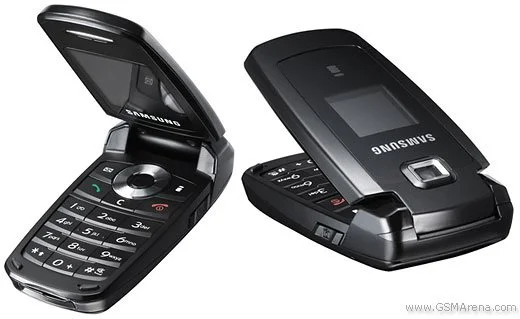
Manufacturer: Samsung
Network: O2
Released: 2006
When I Used It: 2006-2008
Do I Still Own It: Yes
Would I Still Use It: Absolutely
Image Source: GSMArena.com
The Samsung S401i was now my ninth phone in 6 years, and only the third that I had purchased completely legitimately, although I don’t recall how much it cost at the time, it had only been recently released when I purchased it, and so wouldn’t have been less than £60-£70. And this phone was fantastic.
The camera was superb quality, it was built solid as a rock, the screen was bigger than the Samsung E600, as was the keypad by a small margain, but it was enough to solve the size issues I had using the E600.
The most interesting feature on the S401i was a competitor technology to WAP called i-mode, which was released in 1999 and primarily available in Japan for several years, berfore finally making it’s way to European devices after the huge success it had shown in Japan. With i-mode users would also be issued an @O2imail.co.uk email address which made it easy to send emails and images directly from the phone using i-mode.
This phone lasted me a long time compared to my other handsets, and I don’t really know why I stopped using it, but some time around 2008 I think I just wanted a change, and as such I was given a yet another phone by someone I was seeing at the time.
Samsung E250
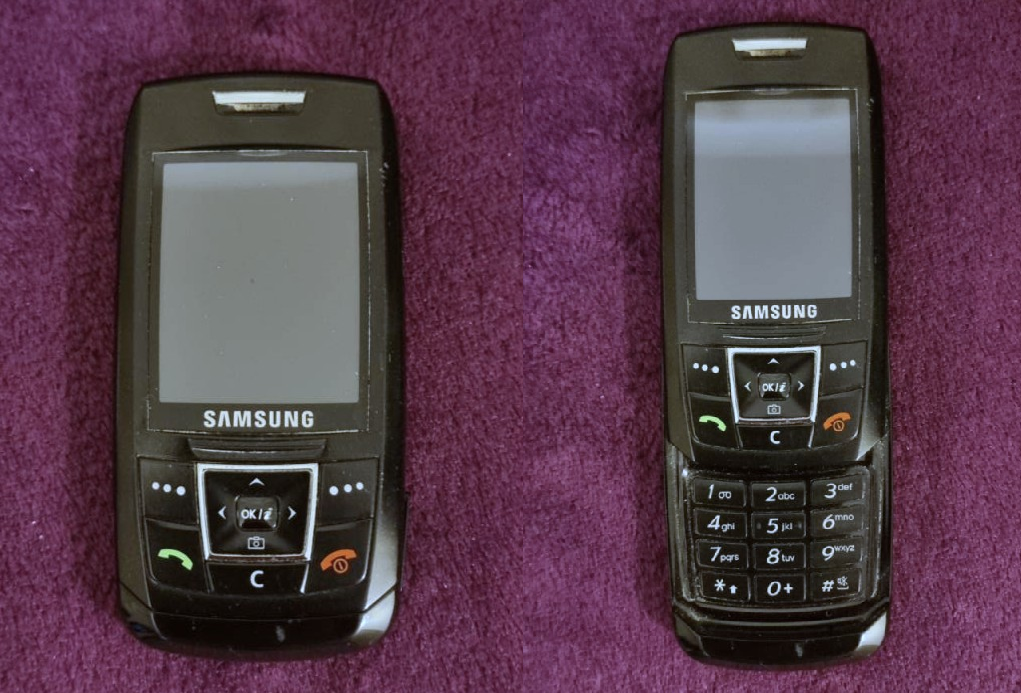
Manufacturer: Samsung
Network: O2
Released:
2006
When I Used It:
2008-
2009
Do I Still Own It: Yes
Would I Still Use It: Yes
Image Source: © 2026 BoomstickFlip
This phone was released only a few months later than the S401i, adopting the slide design as opposed to a clamshell design, and featured several feature upgrades.
Whilst this phone only had a staggering 10MB internal memory, it was the first phone I owned to feature a MicroSD slot, meaning I could store hundreds of MP3’s, photos, and videos on it, and when using the supplied bespoke headphones, this phone essentially became an MP3 player. The screen was also much bigger than the S401i, and featured the option to download games, whereas the S401i only had two preinstalled. Overall this phone was just a general all round upgrade to my previous, and much like the other Samsung’s I owned, the build quality was solid, and I was really starting to fall in love with Samsung as a brand at this point. But times were changing, the iPhone had now been out since 2007, and it was time to truly enter the future of mobile phone technology.
Samsung S3650 / Genio Touch / Corby
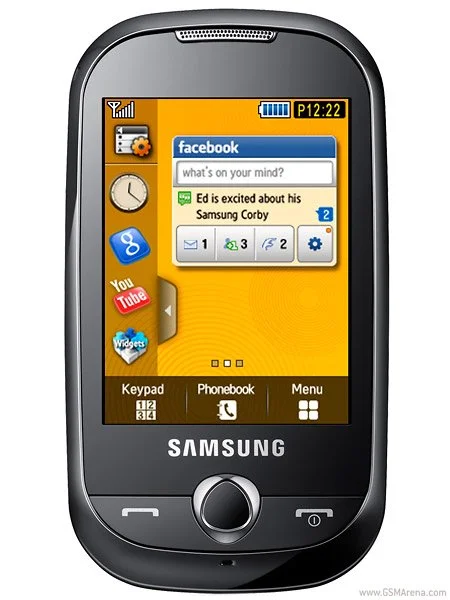
Manufacturer: Samsung
Network: T-Mobile
Released:
2009
When I Used It:
2009-
2010
Do I Still Own It: Yes
Would I Still Use It: No
Image Source: GSMArena.com
Touchscreen smartphones were well and truly here, and while the slightly more financially endowed people were busy with their iPhones, Tocco’s, and Cookie’s, I was only able to afford the new Samsung Genio Touch (as it was marketed in the UK) with a courtesy staff discount from the staff in the Carphone Warehouse store next door to where I was working at the time. If I remember the phone cost me around £120-£130, which at the time was a hell of a lot of money for me.
The Genio was essentially a stripped down smartphone, and was more of a fashion statement than a real contender to Apples iPhone which was dominating the market at the time. It featured changeable coloured backplates, of which it came with four different colours and designs in the box, but as this phone never really took off and became a staple handset, I don’t recall ever seeing aftermarket backplates being sold, although I’m sure some companies probably were selling them.
I sort of liked this phone, but the entire time I owned it, I always felt like I was in the shadow of my friends fancier iPhones, and whilst it was still Samsung Quality, it just didn’t feel as good in the hand as my previous Samsung handsets, and it wasn’t long before I was wanting something new and a lot cooler.
Again, there are no major interesting stories or memories really attached to this phone, and as I stated in the beginning of this blog, I feel that this is very much due to the case that mobile phones were no longer exciting and new, and were becoming more of a general day to day use item that basically everybody owned in one form or another. For me the Samsung Genio Touch was really the last genuinely aesthetically interesting phone I owned, as we were quickly entering the dull yet functional black box era that seems to doom all technology eventually.
I bought another brand new in June of 2010, but before we get to that, I feel I should make a couple of honourable mentions.
Honourable Mentions of 2010
The following two phones I owned very briefly in 2010 during the time I was using the Genio Touch. One was only for around a month, and the other for just 10 days, for reasons that will be explained. So I’m including them here as honourable mentions as they both actually do have somewhat interesting stories attached to them despite how short lived they were.
LG KP500 / Cookie
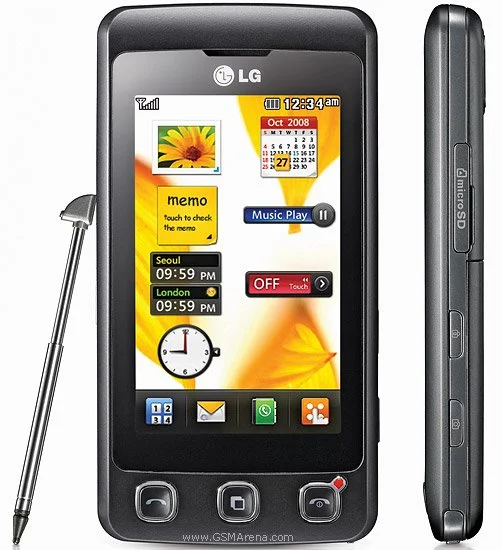
Manufacturer: LG
Network: T-Mobile
Released:
2008
When I Used It:
2010
Do I Still Own It: No
Would I Still Use It: Probably not
Image Source: GSM Arena.com
I briefly used this phone for a month. I certainly didn’t intend for it to be just a month, in fact it was going to be the replacement for my Genio and would be my first true Smartphone. But fate had other plans in mind.
My mum and her partner at the time had been to the a place called the Isle of Sheppey for the day. This is a small island just off the North West Kent Coast, which as a whole unfortunately has a bad reputation and is the butt of many jokes to those from Kent, but it features all your regular seaside attractions like arcades, several beaches, weekly markets, and some relatively small but nice countryside walks if you know where to go. Whilst walking along one of the beaches in a part of the island known as Leysdown-on-Sea, my mum and her partner came across a bag that seemed to have been forgotten by their owners. The bag contained all your usual beach supplies like bottles of drink, sunscreen, etc, but also three mobile phones, likely placed in the bag to keep them safe from the sand. I forget the other two models, but one of them was an LG Cookie, a very popular phone at the time of its release in 2008.
The Cookie was the only phone that did not have a passcode lock on it and so once my mum and her partner returned home, we attempted to contact the owners. We concluded the Cookie was likely a teenagers phone based on the photos, and the only family members numbers we could find were “Mum”, “Dad”, and “Home” which was a landline number. We tried both “Mum” and “Dad” and while we expected the other two phones to ring, instead a recorded message stated both numbers had been disconnected, likely by the owners upon realising they were missing, so that was a dead end. So we called the “Home” landline number, but oddly enough we also received a recorded message stating that this number had also been disconnected. We tried calling a few other random numbers in the phone but to no joy, no-one would pick up. It was almost as if this family had disappeared. The items were handed to the Police as lost property, and several weeks later we were informed that they had attempted to contact the owners based on the IMEI numbers, but no-one had come forward to claim the property, and they stated that as a result of this we could keep the items as finders.
Once collected, I paid my mum about £30 and she somewhat reluctantly allowed me to take the LG Cookie. This was it. I finally had a legitimately cool touchscreen phone… for an entire month.
One day I was in the living room, and on my hands and knees looking for something under our coffee table, when all of a sudden I heard a loud “POP!”. I was 24 at this point, so my knees were definitely still good, but alas my LG Cookie was not, as at some point it had fallen out of my pocket on to the floor, and I had inadvertently knelt directly on the touchscreen, breaking it immediately. I was gutted. There was no way I could afford the repair, and there was certainly no way I could ask my mum for help with it. So back to the Genio it was.
Samsung E1120
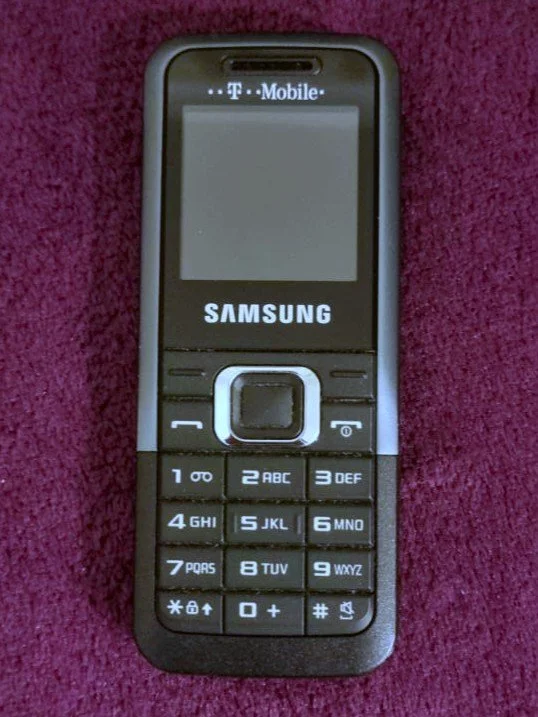
Manufacturer: Samsung
Network: T-Mobile
Released:
2009
When I Used It:
2010
Do I Still Own It: Yes
Would I Still Use It: No
Image Source: © 2026 BoomstickFlip
In 2010 I went on a 10-day cruise around the British Isles. Spending all that time on a boat, and traveling abroad, I was concerned about taking my Genio with me in case I lost it abroad or dropped it overboard. So I bought what is commonly referred to as a burner phone. This phone cost me £15 from Carphone Warehouse, and was so cheap, I bought two, as my girlfriend at the time had an iPhone, and she was notoriously clumsy and therefore very likely to lose her iPhone somewhere along the way.
The phone was as basic as phones get. No camera, no Bluetooth, no SD slot, no internet, although it did have a few games. I got it as a PayAsYouGo, loaded it up with a small amount of credit, entered only close family phone numbers in to it, and we set off on our merry way. Mid way through the trip however, when I finally decided to text some family members to let them know how it was all going, it wouldn’t send any messages. What a piece of junk, I thought at the time, alright it was cheap, but it should at least carry out it’s basic functions. It was a good few hours later, whilst I was sitting in The Gravity Bar at the Guinness Brewery trying to call my Dad back in England, that I realised why it hadn’t been working. When I sent my first few messages, we were somewhere in The Irish Sea between the North of England and Ireland heading towards Dublin, and it would seem that the boat was at that point closer to Ireland than England, meaning I was no longer in the UK. When I had stored the numbers in my phone, I stored them as standard 11 digit UK mobile numbers, starting with the 0 at the beginning. What I neglected to realise is that for a good part of the cruise, we were' not only going to a few foreign countries, but we would also be in foreign waters, meaning I should have stored the numbers with the UK Country Code +44 at the beginning. Feeling like a complete and total idiot at that point, I adjusted all the numbers in the phone book to include the Country Code before finally watching hundreds of messages pour out of the phone that had backed up as unsent
That concludes my two very short lived honourable mentions of 2010. So lets continue on.
blackberry curve 8520
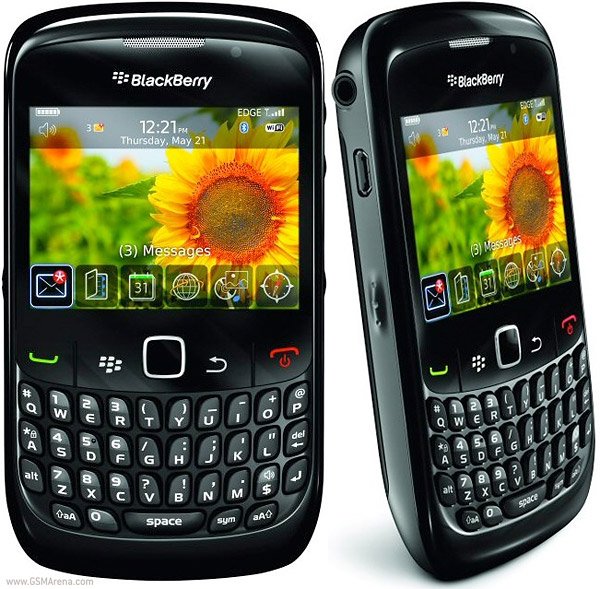
Manufacturer: BlackBerry
Network: T-Mobile
Released:
2009
When I Used It:
2010
-2012
Do I Still Own It: Yes
Would I Still Use It: Yes
Image Source: GSMArena.com
During a brief summer romance in 2010, I was formally introduced to BlackBerry. And this was probably the last phone, aesthetically at least, that I was genuinely excited to own.
I had heard of and seen BlackBerry phones around, but I had never actually held, used, or seen one up-close in person, so the concept was still rather new to me. The person I was seeing owned a pink Curve 8520, and whilst I wasn’t necessarily a fan of the colour, I was an immediate fan of the phone itself. It was built solid like my previous Samsung handsets, looked cool, and felt great in the hand. An issue I have always had with touchscreen phones, even today, is that it is very easy to accidentally hit the wrong letter when typing; I have big hands that were never designed for small touchscreen keyboards. And whilst predictive text had improved number pad typing, it could still be slow and tedious if the predictive text system on the phone wasn’t particularly intuitive, and so with it’s tactile QWERTY Keyboard, the BlackBerry for me, was an obvious solution to this issue, and I immediately bought one for myself. Finally I owned my first true smartphone.
Aside form the obvious keyboard function, the BlackBerry also boasted several features that my previous phones didn’t have. It was the first phone I owned that could connect to the WiFi, had a PC style internet browser, an optical track-pad mouse, a standard 3.5mm headphone jack so I could use any headphones of my choice and not just lower quality cheap stock headphones other manufacturers supplied, and it had a staggering 256MB internal memory with a microSDHC card slot, for thousands of MP3’s to go along with that 3.5mm jack. It had everything I could possibly need. For now at least.
I used this phone for just under two years, but eventually I started to notice it was lacking compared to my friends phones. My partner at that time had recently been given a Samsung Galaxy S3, and most of my colleagues owned iPhones. Whilst BlackBerry was popular for a time, they just couldn’t compete with Apple and Samsung, and as such the BlackBerry apps lacked in comparison to Apple and Android, game developers weren’t building for BlackBerry, the bespoke BlackBery Messenger (BBM) app soon became very quiet as more people moved away from BlackBerry, and it was obvious that at the rate smartphones were progressing, my Curve 8520 just wasn’t cutting it anymore. I had serious FOMO, and it was time to move on again. And this time Apple was knocking at my door.
apple iphone 3gs
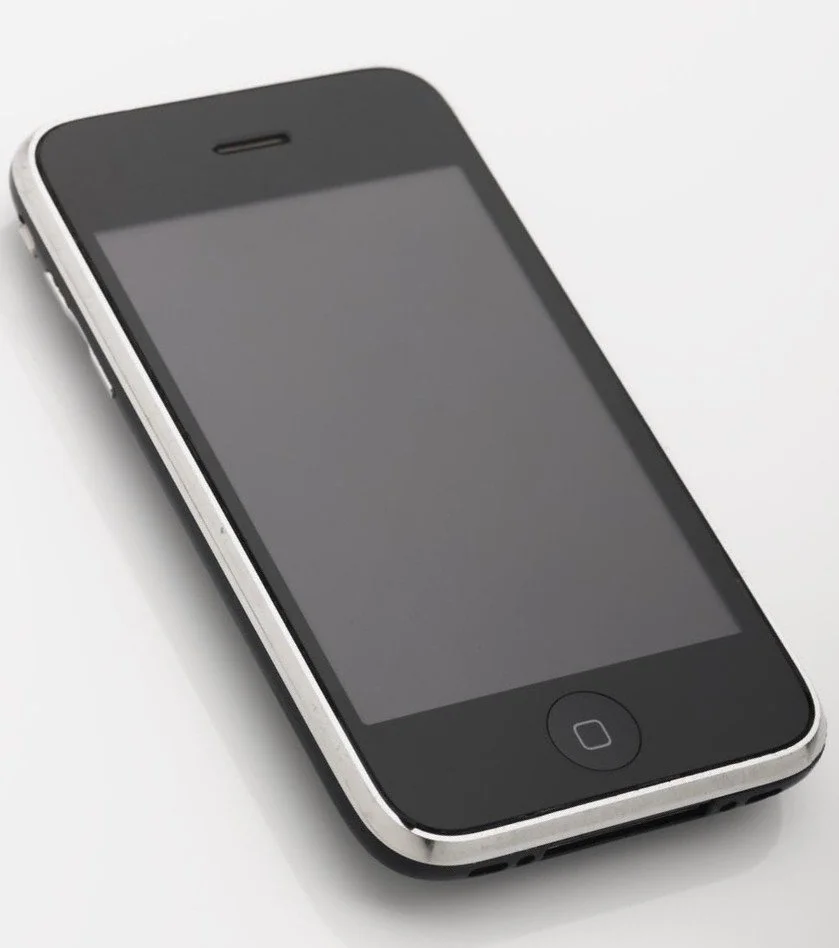
Manufacturer: Apple Inc.
Network: O2
Released:
2009
When I Used It:
2012-2014
Do I Still Own It: Yes
Would I Still Use It: No
Image Source: The Science Museum / Licence CC BY-NC-SA 4.0 Licence
In early 2011, at the grand old age of 26, I finally moved out of home and into a houseshare with my now ex-wife. I had been working part time for a photographic company called Jessops since 2008, going full time around 2010, but the company was plagued with financial issues, and soon after moving out, I lost my job in July 2011. The world was still reeling from the 2008 recession, and it would be a grueling six months on benefits before I found another job with Pets at Home in January of 2012. And with this job came a decent hourly pay rate and the endless opportunities for overtime. By March 2012 I was feeling pretty flush and decided its about time I treated myself to a new phone, and my first mobile phone contract.
The iPhone 3GS had been on the market since 2009, and by 2012 the 16GB and 32GB had already been discontinued for 2 years, while the 8GB version still had a few months left of its life, and was being offered on some very reasonable contracts through O2 at the time.
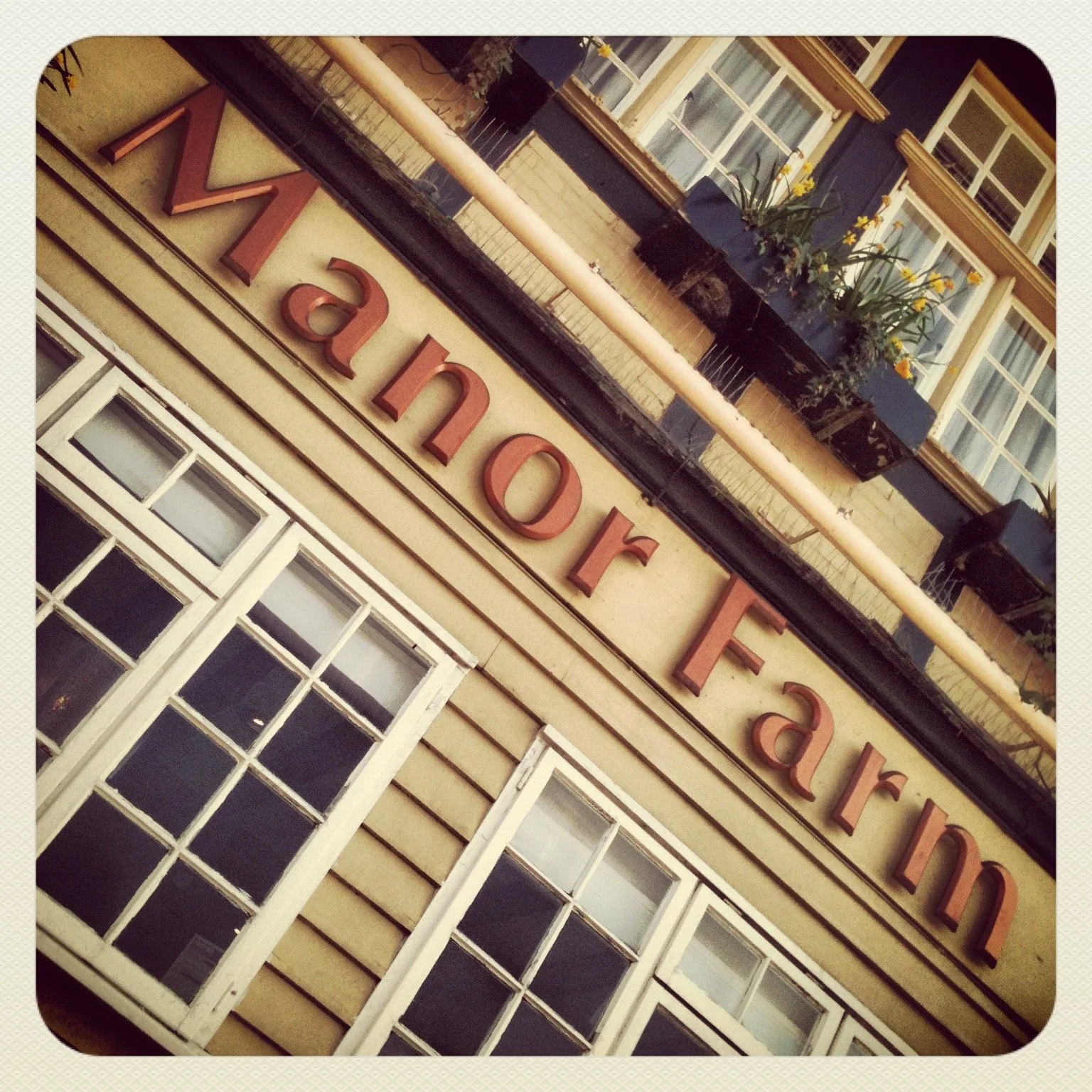
The contract I secured was 12-months, costing around £30 a month, for a total cost of around £360. This by far was the most expensive phone I had ever owned, and the day I received it, I immediately set about downloading all the apps and games I had missed out on whilst using my BlackBerry, glued to it for hours. One app in particular that I was looking forward to using was a relatively new and fresh app called “Instagram”. You may have heard of it. This was of course when Instagram was still in its early days and was a legitimate photo sharing app, mostly populated by photographers, amateur and professional alike, before eventually evolving in to the hell-scape of advertising and influencers that it has become today. I in fact still have my very first photos I ever took on my 3GS and shared on Instagram the day I received the phone:



My 3GS lasted the life of its 12 month contract, but during the next year it began to suffer from issues with battery life and performance, to the point where it was becoming difficult to use. I had also purchased an Apple iPad Mini in 2013 and was slowly coming to realise that I did not like iOS at all, and far preferred my ex-wifes Samsung Galaxy S3 and the Android operating system.
The relationship and marriage ended in October 2014, and by December of that year I had moved out of the house we rented, and was back living at my mum’s. I was naturally pretty down and struggling with the break-up, so on new years eve 2014, my friend James invited me to a new years party. At this point I had worked my way up to Assistant Manager at Pets at Home, and by moving back into my mum’s, I suddenly realised I had a lot more disposable income again. So I decided on the 31st December 2014, it would be a new year, new me, and new phone.
Samsung Galaxy S4
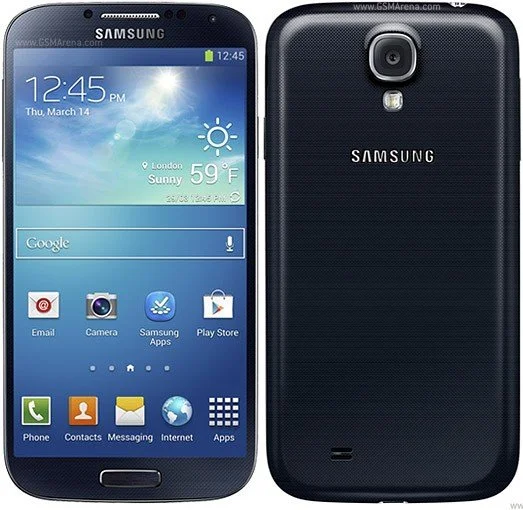
Manufacturer: Samsung
Network: O2
Released:
2013
When I Used It:
2014-2017
Do I Still Own It: No
Would I Still Use It: Maybe
Image Source: GSMArena.com
On the 31st December 2014, I went back to Samsung, with my first of several Galaxy Series phones. Myself, much like the mobile phone industry, had well and truly entered the dull but functional black box era. There was plenty going on under-the-hood, but aesthetically, it was just a black slab, with a screen.
I bought the phone outright from Argos as I was earning enough at the time and didn’t want another contract, and the first photo I took on it was a selfie of myself, James, and his housemate Jamie at that New Years Party. It was taken at 01:01am on 01/01/2015, and I still have the photo.
I replaced my Galaxy S4 in August of 2017, after I had started my current job and was earning even more money, and gave my brother, who needed a phone at the time, my Galaxy S4. I kind of owed it to him after borrowing his Nokia 3310 without permission all those years prior, but unfortunately I think he no longer has the phone.
From here, the phones and their stories just get boring. Mobile phones had already long become part of every day life, evolving from new and exciting technology, to just something I have in my pocket. There’s no real stories anymore, and whilst each phone has the odd new feature here and there, they all generally look the same, do the same job, and my only real reason for changing was being offered upgrades by my provider, but I’ll continue to list them, right up until the phone I’m using today.
Samsung Galaxy S7
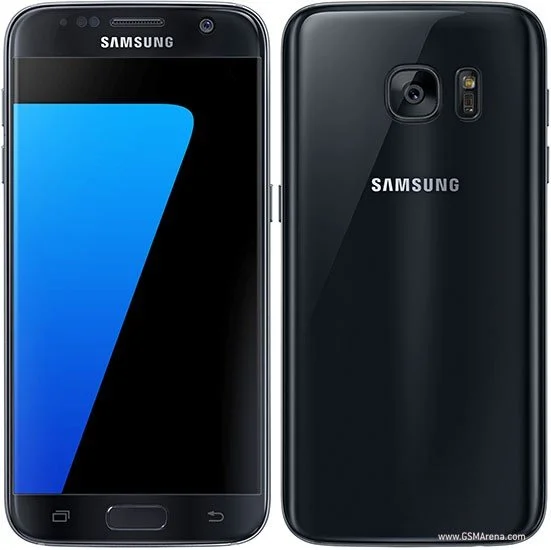
Manufacturer: Samsung
Network: EE
Released:
2016
When I Used It:
2017-2019
Do I Still Own It: Yes
Would I Still Use It: Yes
Image Source: GSMArena.com
Samsung Galaxy S10
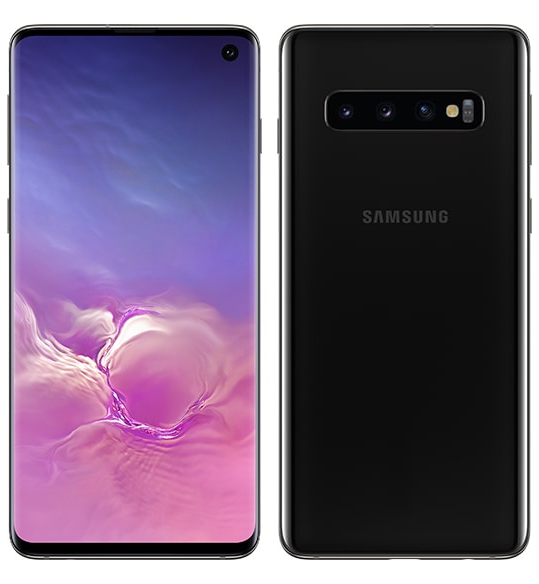
Manufacturer: Samsung
Network: EE
Released:
2019
When I Used It:
2019-2021
Do I Still Own It: Yes, my partner is using it
Would I Still Use It: Yes
Image Source: Samsung.com
Samsung Galaxy S21 Ultra 5G
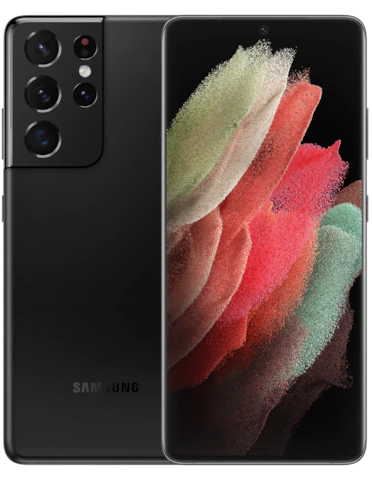
Manufacturer: Samsung
Network: GiffGaff
Released:
2021
When I Used It:
2021-Present
Do I Still Own It: Yes
Would I Still Use It: I currently am.
Image Source: Samsung.com
And that’s it. The Samsung Galaxy S21 Ultra 5G is the phone I’ve used since April 2021 and still use today in 2026.
This is the longest I’ve ever owned a phone as I’ve come to realise that upgrading every two years rarely offers me anything new, and why pay almost £100+ a month for a brand new phone on a two year contract, every two years, for one or two extra features that literally won’t change my life, when I can keep my current, fully functional phone, and only pay £10 a month on a rolling contract. I initially upgraded to the S21 on EE but changed to O2 once the contract ended as I found a better rolling monthly deal, before swapping to giffgaff late last year for the same reason. As for the phone itself, I take care of my phones, keep them in cases and always make sure I have a screen protector, so almost 5 years on this phone is still in near mint condition and is showing no signs of slowing down yet.
So I guess the big question is, when will I replace it, and what with? Samsung currently still support the S21 with regular updates, so it’s unlikely I’ll change anytime soon, but over the last few years I’ve worked very hard to “de-Google” my life and especially my phone. I disagree with Google’s data harvesting and selling policies and hate that every inch of my phone is feeding that data to Google at all times, equally the same with companies like Meta. So I’ve stopped using, and deleted, the vast majority of these apps and services, and replaced them with secure, more transparent Open Source alternatives (maybe I’ll blog that whole journey at some point), but the fact remains this phone is still an Android, and so it’s still Google. So when Samsung stop supporting my S21 specifically with security updates, the likelihood is I will move away from Android entirely, and iOS for that matter. I’ve been looking into e Foundation’s e/OS, which is an Android experience that’s open source and features zero Google apps and services, and feel like this, or something similar, is the future for me.
As for any future handsets, I’d like something a bit more sustainable. Whilst I take care of my phones, insure them, and have rarely needed repairs, I’m a keen supporter of the Right to Repair movement, and so I’ve been looking into several modular phones from smaller manufacturers as options for the future. These phones may not be top of the line, and will likely be a downgrade, but these are the companies that are, in my opinion, truly leading innovation now, and all it’ll take for them to succeed is for more of us to risk embracing them.
So that’s it. 25.5 years, 17 phones (19 including the honourable mentions), averaging one phone every 1.5 years. There were definitely far more crazy, experimental, and innovative mobile phones released in that time, but they were always well out of my price range, and so this was just a look at my personal journey.
Was this interesting? I hope so. Those of you who grew up with, and have only known black slab smartphones, might enjoy looking at how things were when I was younger, and I hope those of you who were on the same journey as me enjoy the small nostalgia trip, but either way, I hope you enjoyed reading, and reliving this journey with me.
Now, put your phone down, and go do something more productive.